A family history
From Wolica
to the prairie
Two villages in south-east Poland, a war spent on German farms, a ship called Batory, and a farm near Alonsa, Manitoba. Assembled for the family, November 2026.
Roman Pacuła and Maria Ferenc grew up two villages apart in the parish of Urzejowice. Roman spent the whole Second World War as a prisoner on a farm in Germany. Sixteen years after it ended, they crossed the Atlantic with their five children to join his brother on a Manitoba farm.
Chapter one · 1906 to 1939
Wolica and Białoboki
Two small villages, a few kilometres apart, in the farm country between Łańcut and Przeworsk.
When Roman Pacuła was born in Wolica in February 1914, this corner of Poland was Galicia, a province of the Austrian empire; by the time he was five it was Poland again. His parents were Karol Pacuła and Agata Wójtowicz, farmers. There were at least six children: Adolf, the eldest, born in 1906, then Roman, then Henryk in 1916, and three daughters, Wiktoria, Joanna and Anna.
Maria Ferenc was born on 27 January 1925 in Białoboki, the next village over, the youngest of five children of Jan Ferenc and Zofia, whose maiden name the family remembers as something like "Schlink". It is almost certainly Szlęk, a surname found mostly in Gać and Markowa. Her brothers were Edward, Józef and Stanisław, and her sister Stefania.
Wolica and Białoboki both belonged to the Catholic parish of Urzejowice and today to the municipality of Gać, the "Gochy" of family memory. Each village kept its own register book, and those books are still in Poland and not online, which is why Roman's and Maria's own birth records are not yet on this page. They have been requested.
One family story placed Roman's birth in "Katowitz", the Silesian city of Katowice. Every record found so far says Wolica, for Roman and for Henryk.
Chapter two · 1930
Adolf goes first
Thirty-one years before the rest of the family, the eldest brother left for Canada.
Adolf Pacuła was 24 when he emigrated in 1930, sailing from England to Quebec, one of many young men from this part of Poland who went to the Canadian prairies between the wars. He settled in the Alonsa district, on the west side of Lake Manitoba, and farmed there for forty years. The voters lists find him at Alonsa in 1945, 1949, 1957 and 1962, listed as a farmer.
He never went back. When Roman decided to bring his own family to Canada in 1961, it was to Adolf's farm that they went.
Chapter three · 1939 to 1945
Prisoners, 1939
The family remembers two brothers in the same camp, somewhere in Poland. The papers tell a different story.
When Germany invaded in September 1939, Roman was 25 and Henryk 23, both of an age to serve. Both were taken prisoner. Henryk was a private in the 3rd Infantry Regiment from Jarosław, captured at the fall of the Modlin fortress on 28 September 1939 and registered at Stalag I A Stablack in East Prussia as prisoner number 27936.
Roman went west, to Hümme, a farming village north of Kassel in Hesse. A list of foreigners drawn up for the Allies after the war records him there as a prisoner of war from 1939 to 1945. A handful of other Polish prisoners arrived in Hümme with him. Prisoners there belonged to Stalag IX A at Ziegenhain; no document yet names Roman's camp or his prisoner number.
In 1940 Germany began stripping most Polish prisoners of their prisoner status and turning them into civilian farm labourers, usually on the same farm. A Polish record dates Roman's release from captivity to November 1942. Henryk turns up in September 1942 as a farm labourer near Eckernförde on the Baltic coast, "Pacula, Heinrich, born 26.3.16, Wolica".
So the brothers were never in the same camp, and Adolf was in Canada the whole time. The "camp in Poland" is most likely Henryk's: part of the old Stablack site lies inside Poland today.
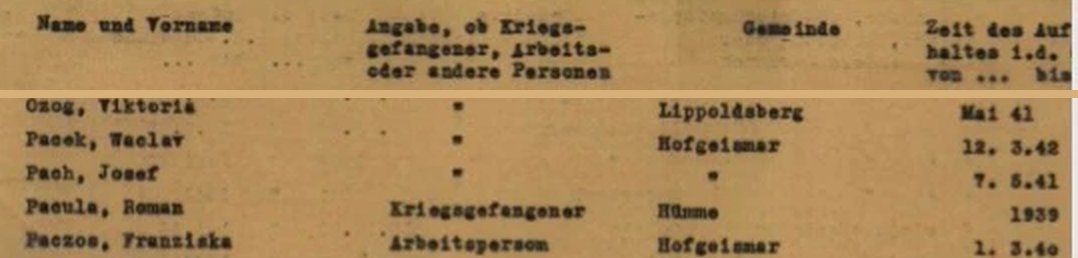
Arolsen Archives, DocID 70404150
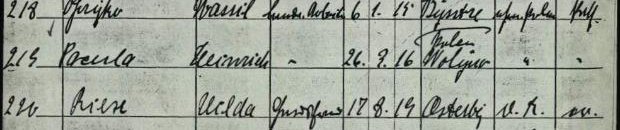
Arolsen Archives, DocID 70610390
Chapter four · 1945 to 1961
Markowa
Roman came home, married Maria, and they farmed in Markowa for sixteen years.
Maria's obituary gives their wedding as 1944, while the German list keeps Roman at Hümme until 1945; one of the two dates is off, and the marriage record in the Urzejowice books will settle it. After the war they made their home in Markowa, a large village of small farms a short distance from Wolica and Białoboki, where neither family had lived before.
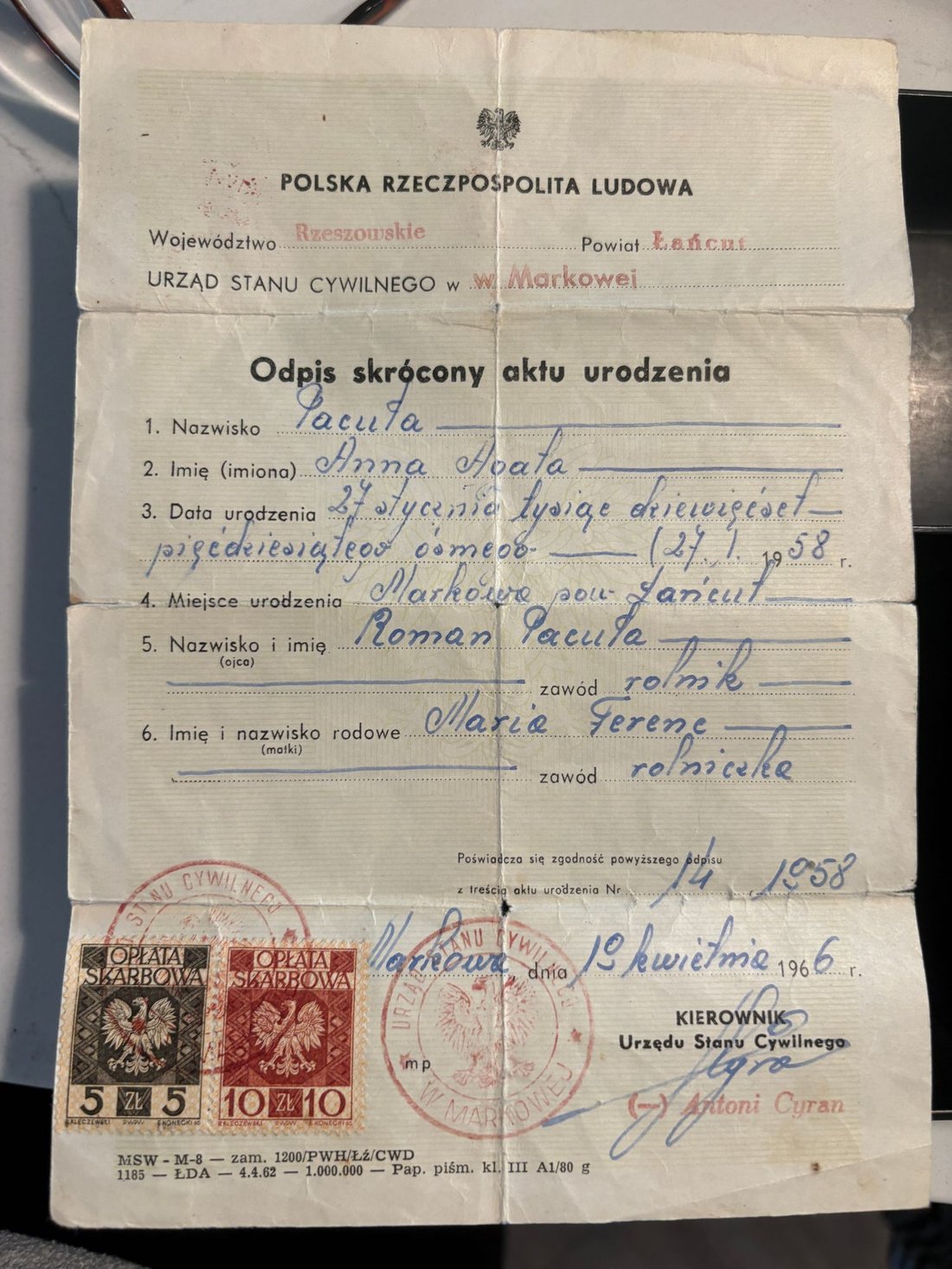
Five children were born to them in Poland: Stanisław and Adolf, the two eldest; Zofia; Helena; and Anna, born in Markowa on 27 January 1958, her parents' occupations entered on her birth certificate as rolnik and rolniczka, farmer.
Markowa is known well beyond Poland. During the occupation the Ulma family hid eight Jews on their farm there; in March 1944 German police shot them all, Józef and Wiktoria Ulma and their six children with them. The village is now home to the Ulma Family Museum of Poles Saving Jews in World War II.
Family papers
Chapter five · May to June 1961
The Batory
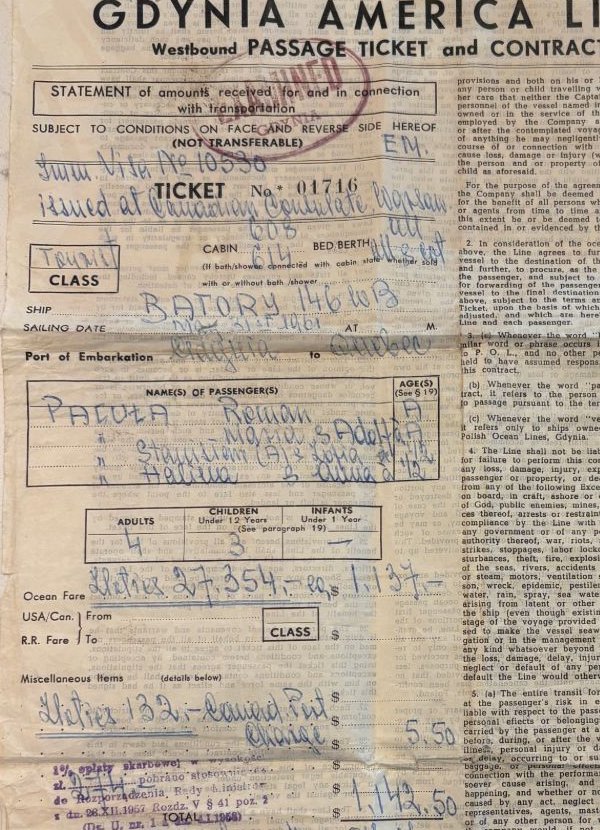
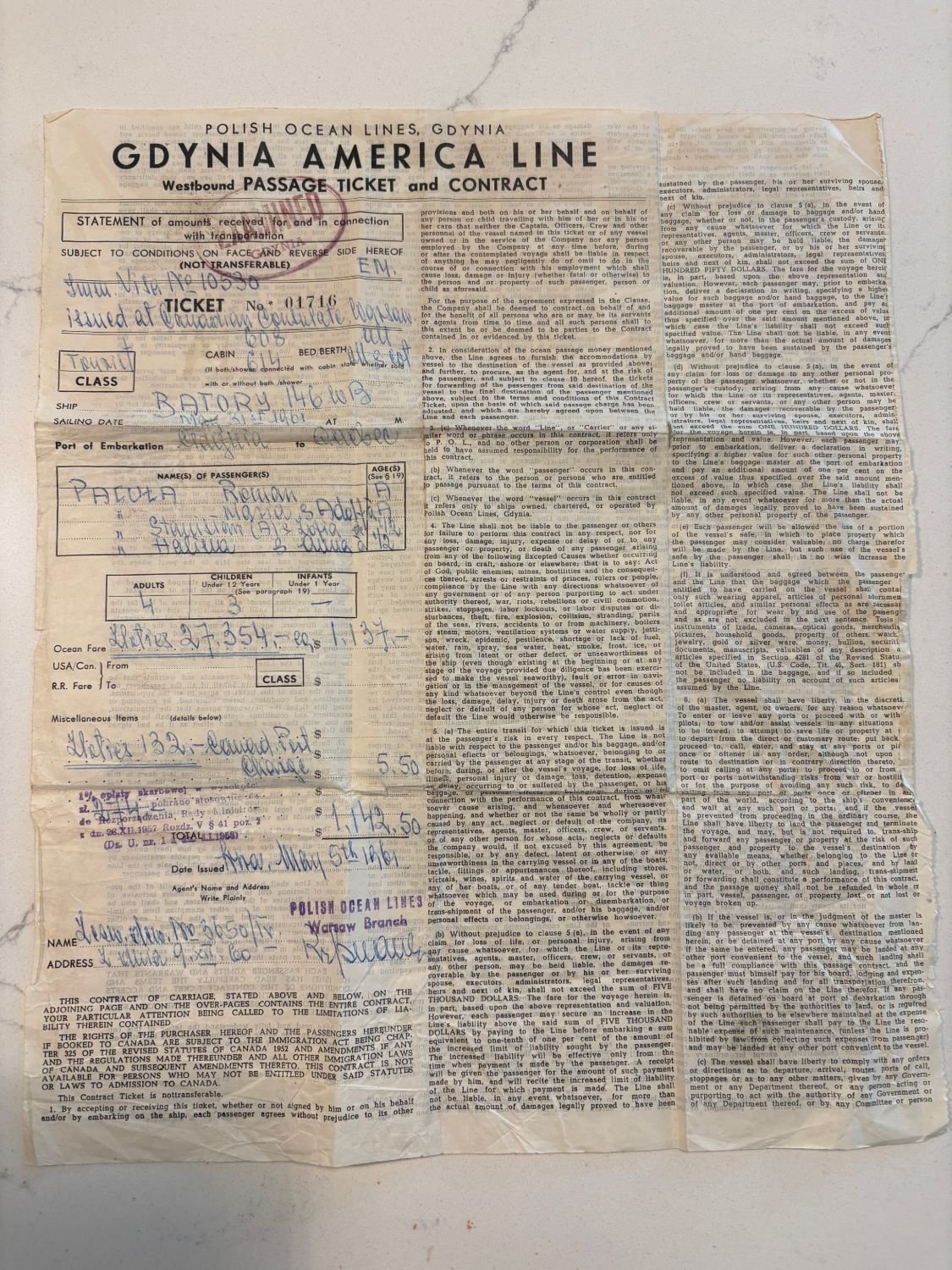
Seven names on one ticket, four adults and three children.
The Canadian consulate in Warsaw issued the immigrant visa, and on 5 May 1961 Polish Ocean Lines wrote out ticket 01716 for the Gdynia America Line: tourist class, cabins 608 and 614, on the MS Batory, voyage 146 westbound, sailing from Gdynia on 31 May for Quebec. Roman, Maria, Adolf and Stanisław travelled as adults; Zofia, Helena and Anna, all under twelve, at half fare.
The fare came to 27,354 złoty, entered beside it as $1,137, plus a Canadian port charge of $5.50: $1,142.50 in all, roughly $12,500 in today's money, for a farming family from a village of small holdings.
They landed on 9 June 1961, at Montreal by the family's account, and took the train west to Alonsa. Anna was three.
Family papers
Chapter six · 1961 to 2018
Alonsa and Portage
From a farm by Lake Manitoba to a house in Portage la Prairie.
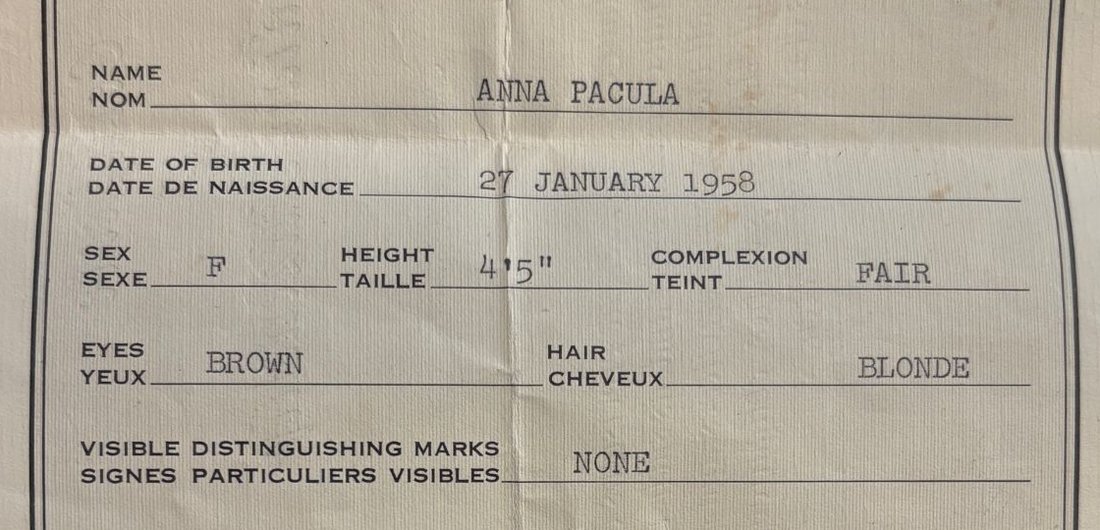
The family's first Canadian home was with Adolf in the Alonsa district, post office Alonsa, probably on or beside his farm. By the 1968 voters list they had moved to Portage la Prairie, where Roman, Maria and Stanley are listed together, and Helen and the younger Adolf by 1972. On 9 January 1967 Anna, now nine, received her own certificate of Canadian citizenship: four foot five, fair, brown eyes, blonde hair.
Adolf farmed at Alonsa until 1970, retired to McCreary, and died in Winnipeg in March 1982, aged 76. Henryk had made his own way to Canada and lived in Montreal as Henry, with his wife Anna and their children Weronika and Thomas; he died there in 2012 at 96. Their sister Ann died in 1981, and Valerie stayed in Poland.
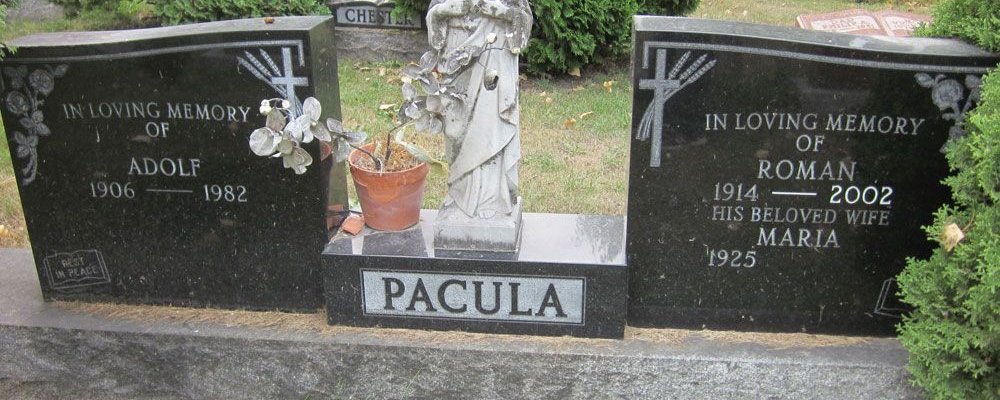
Roman died in 2002. Maria, a long-time member of the Catholic Women's League at Good Shepherd parish, lived to 93 and died in Portage on 13 March 2018. She is buried with Roman, and with Adolf, under one stone at Hillside Cemetery.
Family papers
Photograph: Find a Grave contributor
Chapter seven · Now
The line to today
Wolica and Białoboki to Winnipeg, with everyone in between.
Generation 1 · Wolica
Karol Pacuła & Agata Wójtowicz
Farmers. Children Adolf, Roman, Henryk, Wiktoria, Joanna, Anna.
Generation 1 · Białoboki
Jan Ferenc & Zofia Szlęk (?)
Children Edward, Józef, Stanisław, Stefania, Maria.
Generation 2 · Markowa to Portage la Prairie
Roman & Maria Pacuła
Roman, February 1914 to 2002, prisoner of war 1939 to 1945, farmer. Maria Ferenc, 27 January 1925 to 13 March 2018. Married 1944 or soon after; to Canada 1961.
Generation 3 · their five children
Stanley & Mary
Adolf & Helen
Sophie & Bill
Helen
Anna & Ross
Generations 4 and 5 · Winnipeg
Megan & Matt · Frieda & Ella
Anna's daughter Megan, and her daughters. Every other grandchild and great-grandchild of Roman and Maria belongs here too: send names and they go in.
Chapter eight · Sources
How we know
- Family papers: Anna's Polish birth certificate (Markowa, act 14/1958); the Gdynia America Line ticket, 1961; Anna's certificate of Canadian citizenship, 1967.
- Arolsen Archives, Bad Arolsen: list of foreigners in Kreis Hofgeismar (DocID 70404150); registration book of foreign workers, Amt Hütten (DocID 70610390).
- Institute of National Remembrance war-losses database (straty.pl): Roman Pacuła, Wolica, prisoner of war 1939 to 1942 (IPN Rz 367/33); Henryk Pacuła, Stalag I A, no. 27936, from the Central Prisoner-of-War Museum, Łambinowice.
- Parish registers of Urzejowice, digitised at metryki.genealodzy.pl, and the Geneteka index: the parish, its villages and local Pacuła and Wójtowicz families.
- Canada voters lists, 1945 to 1974; Maria's obituary (2018); Adolf's obituary (1982); the Hillside Cemetery monument; Henry Pacula's death notice, Montreal, 2012.
Still to come
Roman's and Maria's birth records and their marriage, from the Wolica and Białoboki books; Roman's camp and prisoner number; the exact place of the Alonsa farm. All have been requested.
If you have something, it belongs here
A photograph of the farm at Alonsa or the house in Markowa. A letter from Valerie in Poland. Something Roman said about Hümme. A prayer card, a passport, a story. Send it to Matt and it goes on this page.